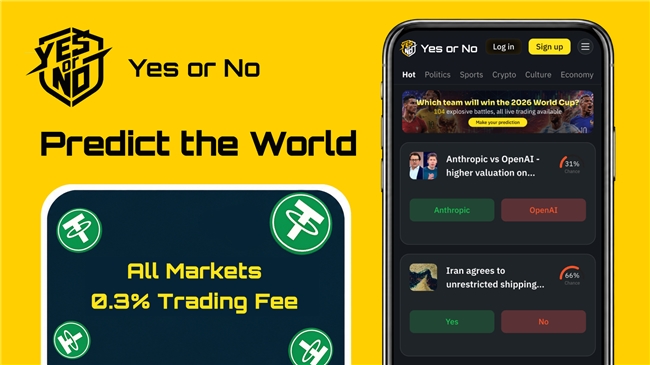
 Keywords: Artificial Intelligence, Prediction Markets, Collective Intelligence, Probability Forecasting, Decision-Making, YesorNo, Web3 Artificial intelligence is becoming an increasingly important tool for processing information. From summarizing research and analyzing financial data to interpreting sporting events and scientific publications, AI systems can identify patterns and generate insights faster than ever before. As these technologies continue to improve, a new question has emerged. Can artificial intelligence also help people understand uncertainty? Many real-world decisions involve incomplete information. Whether forecasting economic trends, evaluating scientific developments, or estimating the outcome of a sporting event, certainty is rarely possible. Instead, people make decisions based on changing probabilities. Prediction markets approach this challenge from a different perspective. Rather than generating a single answer, they continuously reflect how many independent participants interpret available information. Together, artificial intelligence and prediction markets may provide complementary ways of understanding uncertainty. Artificial Intelligence Organizes Information Modern AI systems excel at processing information efficiently. They can: ● Analyze historical datasets ● Summarize complex reports ● Detect patterns ● Compare large volumes of information ● Generate analytical insights These capabilities allow AI to support research across finance, healthcare, education, sports, and many other industries. However, AI generally produces results based on existing information. Real-world events continue changing after those analyses are completed. Prediction Markets Reflect Changing Expectations Prediction markets focus on a different problem. Rather than producing a forecast from one model, they aggregate expectations from many independent participants. Market prices change whenever participants interpret new information differently. For example, before an international football match, expectations may shift because of: ● Team announcements ● Player injuries ● Weather conditions ● Tactical adjustments ● Official lineups Instead of rewriting a prediction manually, the market continuously updates the estimated probability of each outcome. Why These Systems Complement Each Other Artificial intelligence and prediction markets process information differently. Artificial intelligence focuses on: ● Data analysis ● Pattern recognition ● Historical comparison Prediction markets focus on: ● Collective expectations ● Probability discovery ● Continuous market updates These approaches are not mutually exclusive. AI helps people understand available information. Prediction markets reveal how that information is collectively interpreted. Used together, they provide a broader perspective on uncertain events. Human Judgment Still Matters Even the most advanced AI models cannot directly observe human expectations. Unexpected political developments. Changes in public sentiment. Team morale. Last-minute decisions. These factors often influence outcomes but are difficult to quantify completely. Prediction markets incorporate these changing expectations through continuous participation. Rather than replacing human judgment, they organize it into transparent market signals. Sports Provide a Practical Example International sporting events demonstrate this relationship particularly well. Artificial intelligence can analyze: ● Historical statistics ● Team performance ● Tactical trends ● Injury history Meanwhile, prediction markets continue responding to information that appears throughout the day. As participants reassess probabilities, market prices evolve accordingly. The combination of analytical models and continuously updated market expectations creates a richer picture than either approach alone. Beyond Sports Although sports provide one of the clearest examples, the same framework applies across many fields. Prediction markets increasingly cover: ● Artificial intelligence ● Economics ● Public policy ● Technology ● Digital assets ● Global events In each case, artificial intelligence contributes analytical capabilities, while prediction markets contribute continuously evolving probability estimates. The Future of Probability-Based Decision-Making As artificial intelligence becomes more widely integrated into research and decision-making, understanding probability will become increasingly important. Organizations rarely make decisions based solely on certainty. Instead, they evaluate competing possibilities and continuously update those assessments as new information becomes available. Prediction markets provide one transparent way to observe how expectations change over time. Artificial intelligence helps explain available information. Prediction markets help measure how that information influences collective expectations. Conclusion Artificial intelligence and prediction markets address different aspects of the same challenge. AI improves the way information is analyzed. Prediction markets improve the way uncertainty is measured. Rather than competing, these technologies have the potential to reinforce one another by combining analytical capabilities with continuously updated probability estimates. As interest in probability-based decision-making continues to grow, platforms such as YesorNo are helping make prediction markets easier to understand through a simple and accessible user experience. About YesorNo YesorNo is a decentralized prediction market where users participate in probability markets covering sports, artificial intelligence, cryptocurrency, politics, and global events.
Built around a simple binary market structure, the platform aims to make prediction markets more accessible while supporting transparent probability discovery through open markets. |
来自:
互联网

文中内容和观点 : 不代表本网站立场 ; 合作及投稿请联系 : ceoim@vip.qq.com


